Child labour facts and figures: 138M kids working worldwide. Discover causes, effects, and where child labour is most common.
Nearly 138 million child workers – 59 million girls and 78 million boys – are engaged in child labor worldwide, which represents about 8% of all children globally, with 54 million in hazardous work that threatens their health and safety.
Looking at long-term child labour statistics, child development progress has been made: the number of children in child labour has declined by more than 100 million since 2000. Between 2020 and 2024 alone, child labour fell by 22 million, showing a return to global progress.
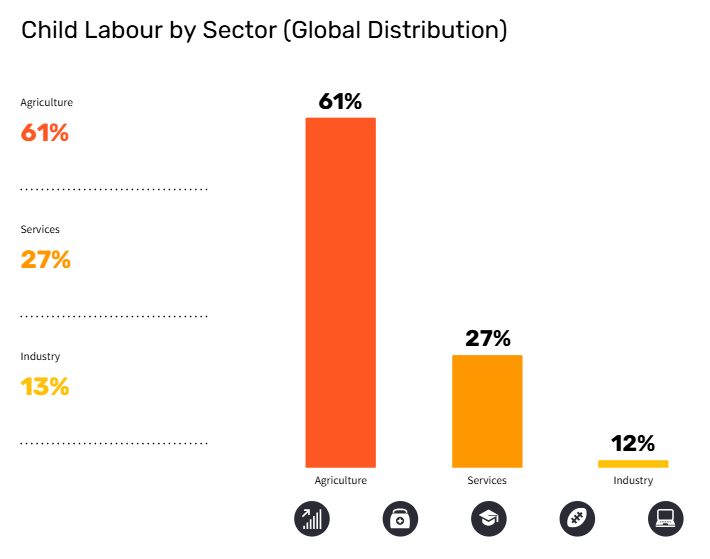
Child labor facts show that the largest share (61%) is in agriculture, often unpaid family work on smallholder farms. About 27% are in services such as domestic work and street vending, while 13% are in industry, including construction and mining.
See also: How to prevent child labor, Child Abuse statistics.
According to UNICEF’s global child labour database (updated June 2025), children aged 5–17 are classified into three distinct risk groups, each facing different thresholds of exploitation. The youngest children — those aged 5 to 11 — are considered to be in child labour if they perform even a single hour of economic activity per week, reflecting how damaging any work is at such a formative age. For children aged 12 to 14, the threshold rises to 14 hours of economic activity or more than 21 hours of unpaid household chores weekly, while adolescents aged 15 to 17 are flagged when they work 43 or more hours per week. Across the 104 countries tracked in the database, the average child labour rate stands at 10.9% for economic activity alone, with boys (11.9%) consistently more affected than girls (9.9%) — a gap that widens sharply in high-burden countries such as South Sudan, Ethiopia, and Haiti.
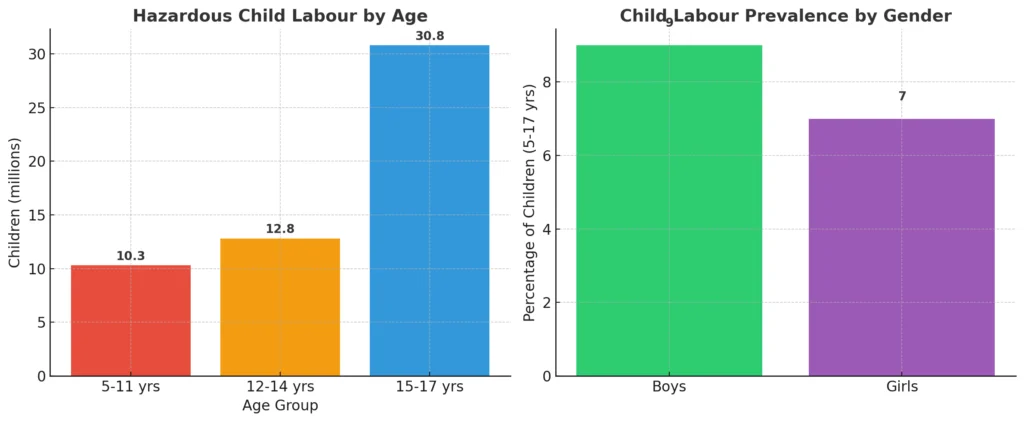
Child labor statistics by gender show that boys are generally more likely to be engaged in child labor than girls, with about 9% of boys compared to 7% of girls affected globally. This disparity tends to increase with age, as boys are more likely to enter physically demanding sectors such as industry, while girls often transition into service-based roles, including domestic work. These patterns highlight how gender norms and economic factors influence the type and prevalence of child labor across different age groups.
These child labour graphs and child labour charts show that as children grow older, boys are more likely to move into industry, while girls shift into service roles.
When examining child labor statistics by country, the data reveals a deeply troubling pattern concentrated in sub-Saharan Africa and parts of Asia. South Sudan tops the list of countries with child labor, with a staggering 48% of children aged 5–17 engaged in economic activity or unpaid household services — making it the answer to the question of what country has the most child labor in the world today. Ethiopia follows closely at 45%, with Burkina Faso, Cameroon, and Chad all reporting rates above 39%. These figures, compiled by UNICEF and the ILO, paint a stark picture of how poverty, conflict, and lack of educational access continue to push millions of children into labor before they ever have the chance to learn.
Percentage of children aged 5–17 engaged in child labour, ranked by prevalence. Data covers economic activity and unpaid household services.
Source: World Population Review · UNICEF & ILO Calculations
Showing 93 of 93 countries
| # | Country | Total | ♂ Male / ♀ Female | Data Source |
|---|
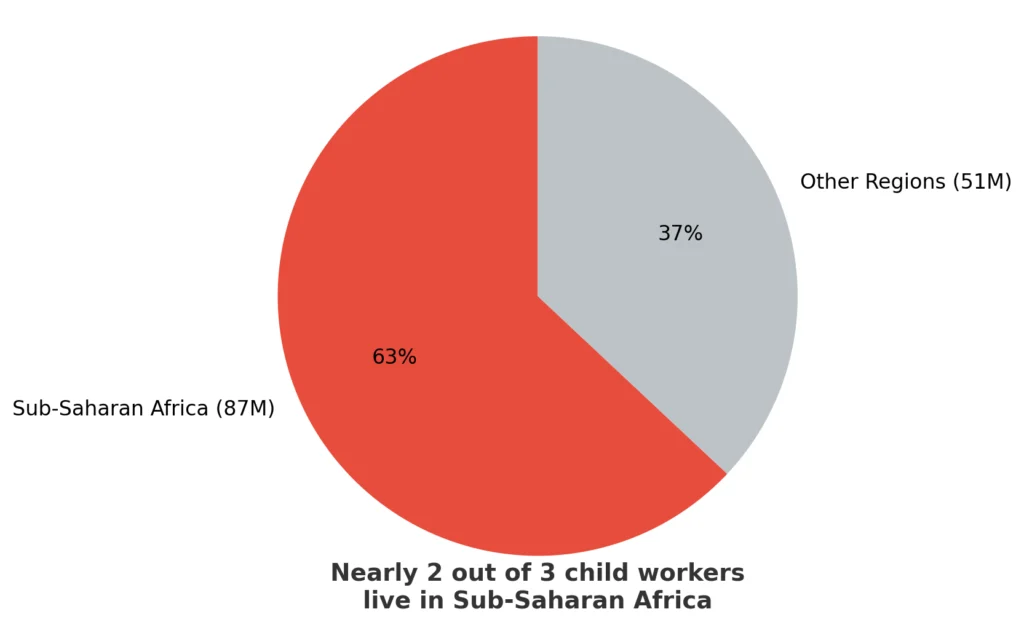
Child labor is most common in Sub-Saharan Africa, where 87 million children are engaged in child labor, accounting for nearly two-thirds of the global total. Despite a 10% decline in prevalence since 2020, population growth means absolute numbers have remained steady.
Asia and the Pacific made the most significant progress, cutting child labour prevalence nearly in half, while Latin America and the Caribbean also saw declines. Yet, child labor around the world remains uneven, with crisis-affected regions having rates more than double the global average.
The leading causes of child labour include poverty, lack of access to education, cultural practices, and economic shocks. In fragile or conflict-affected countries, the rate of child labour is more than twice the global average.
The effects of child labour are severe: it harms children’s physical and mental health, reduces school attendance, and often traps families in cycles of poverty. Child slavery statistics remain alarming, with millions of children still in forced labour, trafficking, or bonded labour.
So, what is child labour today? It is still a widespread issue, though progress has resumed. The goal to end child labour by 2025 (SDG Target 8.7) has not been met. With 138 million kids working worldwide, elimination is still far off.
Facts about child labour confirm that while legal frameworks exist, implementation gaps remain. Is child labor illegal? Yes, in most countries, under international law and national legislation. But enforcement is weak, especially in rural economies.
Looking at child labour research and child labour data, the path forward requires stronger education systems, poverty reduction, and targeted support for the most vulnerable.
See a child in danger? If you are in immediate danger, call local emergency services. For guidance from CPGN, GET HELP.
CPGN is a 501(c)(3)—donations are tax-deductible where applicable. Our goal is to ensure the safety and protection of every child until it is achieved.
See a child in danger? If you are in immediate danger, call local emergency services. For guidance from CPGN, Get Help.
CPGN is a 501(c)(3) — donations are tax-deductible where applicable. Our goal is to ensure the safety and protection of every child until it is achieved.
Copyright © 2026 CPGN. All rights reserved by Majnate LLP | Privacy Policy | Terms and Conditions