
How to discipline a child without Yelling or Hitting: A Positive Approach

- Mark S.
- Last updated 2 July 2026
You promised yourself today would be different. Then the spilled juice, the third refusal to put on shoes, and the endless whining all landed at once, and before you knew it, you were shouting again.
If that sounds familiar, take a breath. You are not a bad parent. Almost every parent on earth has reached that boiling point and felt the wave of guilt that follows.
Here is the reassuring part: the way out is not about being endlessly patient or raising perfectly behaved children. It is about a handful of skills you can learn, practise, and lean on when things get hard. This guide walks you through how to discipline a child without yelling or hitting, using approaches backed by child development experts. No shame, no lectures, just calmer ways to raise a child who listens because they trust you, not because they fear you.
The world’s leading paediatric body could not be clearer. According to the American Academy of Pediatrics, harsh strategies like spanking, yelling, and shaming are barely effective in the short term and do not work in the long term, and they are linked to lasting harm to a child’s development.
Every Child Deserves Safety and Protection
Stand with CPGN as we work to build informed communities and stronger protections for vulnerable children.
Help Protect a Child 🔒 Secure donations are tax-deductible where applicable.Quick Summary: What This Article Covers
In this article, you’ll learn:
⦁ Why yelling and hitting backfire, even when they seem to work
⦁ The real difference between discipline and punishment
⦁ Positive discipline strategies you can start using today
⦁ How to stay calm when your child pushes every button
⦁ Where to turn if things ever feel like too much
Why Yelling and Hitting Don’t Work
Here is the part that surprises most parents: shouting and smacking can feel effective in the moment, because the behaviour often stops. But that pause is fear, not learning. The lesson a child takes away is how to avoid getting caught, not why something was wrong in the first place.
The research is remarkably consistent. UNICEF, drawing on the work of Oxford professor Lucie Cluver, puts it plainly in its guide to positive discipline: shouting and physical punishment simply do not help, and over time they can do real harm.
Repeated harsh discipline floods a child’s body with stress. The American Academy of Pediatrics warns that this kind of toxic stress can affect how a young brain develops, and is linked to higher rates of aggression, anxiety, and difficulty later in life. In other words, the very behaviours we are trying to stop often get worse, not better.
None of this means parents who have yelled or smacked have ruined anything. Most of us were raised that way, and we reach for it when we are stressed and out of ideas. The goal here is simply to hand you better tools.
Discipline Is Not the Same as Punishment
It helps to untangle two words we often muddle together. Punishment is about making a child pay for what they did. Discipline, which comes from a root meaning to teach, is about helping them learn what to do instead.
A punished child learns to fear the punisher. A disciplined child learns a skill: how to wait, how to share, how to calm down. One relies on the parent staying scary. The other builds something the child carries for life.
This is also where the line into harm can blur. If you have ever wondered where ordinary discipline ends and something more damaging begins, our guide on whether corporal punishment counts as abuse is worth a read.
Start With Connection, Not Correction
Most challenging behaviour has a need underneath it: attention, tiredness, hunger, or big feelings a child cannot yet name. When you meet the need, the behaviour often softens on its own.
UNICEF recommends a simple, almost old-fashioned tool: one-on-one time. It can be five minutes or twenty. Phone away, television off, down at your child’s level, fully with them. You can wash up together while you sing, or chat while you fold the laundry. What matters is that your attention is truly on them.
Children who get this kind of attention have far less reason to chase it through bad behaviour. It costs nothing, and it quietly does more than any consequence ever could.
Positive Discipline Strategies That Actually Work
Here are practical, evidence-based approaches you can start using straight away. None of them require shouting, and none require a smack.
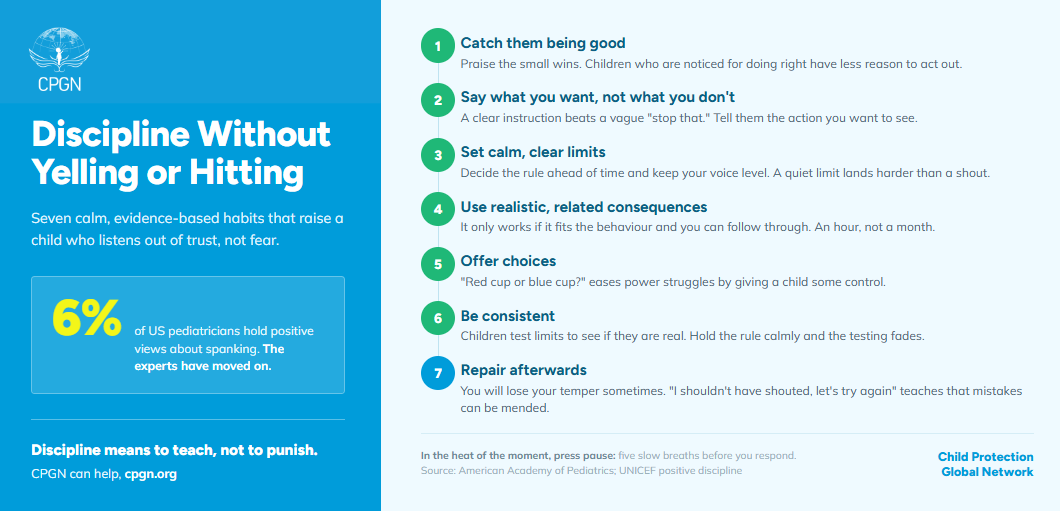
- Catch them being good. We are quick to name what children do wrong and slow to notice what they do right. Flip it. Praise the small wins, like “I love how gently you played with your sister,” and you will see more of them.
- Say what you want, not what you don’t. “Stop making a mess” leaves a child guessing. “Please put the blocks in the box” gives them something clear to do, which makes it far more likely they will.
- Set calm, clear limits. Decide the rule in advance, state it simply, and keep your voice level. Calm does not mean soft. A quiet “we don’t hit, hitting hurts” lands harder than a shout.
- Use consequences that are realistic and related. A consequence works when it fits the behaviour and you can actually follow through. Taking a tablet away for an hour is enforceable; taking it away for a month usually is not.
- Offer choices. Power struggles ease when a child feels some control. “Red cup or blue cup?” or “Shoes first or coat first?” gives them a say while you keep the boundary.
- Be consistent. Children test limits to find out whether they are real. When the rule holds calmly every time, the testing fades. When it shifts with your mood, it grows.
- Repair afterwards. You will lose your temper sometimes. Everyone does. A simple “I shouldn’t have shouted, let’s try that again” teaches your child that mistakes can be mended, which is one of the most valuable lessons of all.
Picture the classic shoe standoff at the front door. The old script is to raise your voice until your child finally, tearfully, complies. The new one: get down to their level, offer a choice (“Do you want to put your shoes on, or shall we race to see who is faster?”), and praise the moment they cooperate. Same goal, very different morning.
Did You Know?
Pediatricians overwhelmingly reject spanking. In one survey cited by the American Academy of Pediatrics, only around 6 percent of US pediatricians held positive views about it. The people who study children’s health for a living have moved on from hitting, and they are inviting parents to come with them.
What to Do in the Heat of the Moment
Strategies are easy to read and hard to remember when your toddler is screaming in a supermarket aisle. So here is the single most useful habit you can build: the pause.
UNICEF calls it the pause button. Before you react, take five slow, deep breaths. It sounds almost too simple, but those few seconds let the thinking part of your brain catch up with the feeling part, so you respond instead of explode.
If you feel yourself losing control, it is completely fine to step away for a moment, as long as your child is safe. Splash your face with water. Reset. You are modelling the very self-control you want them to learn.
And please look after yourself. It is nearly impossible to stay patient when you are running on empty. A short walk, a hot drink in peace, a few minutes that are yours alone, these are not luxuries. They are part of the job.
When It All Feels Like Too Much
Some seasons of parenting are genuinely overwhelming, and some children’s behaviour is harder than average through no fault of yours or theirs. Needing help is not failing. It is parenting wisely.
If your child’s behaviour feels beyond what you can manage, or if you are worried about how you are coping, talk to your doctor, a health visitor, or a family support service. The American Academy of Pediatrics also offers free, parent-friendly guidance through its Healthy Children resource on positive discipline. Reaching out early can change everything.
This article offers general guidance and is not a substitute for professional advice. If you are worried about your child’s wellbeing, or your own, please speak with a qualified professional or contact a local family support service.
Discipline Rooted in Respect
Raising a child without yelling or hitting is not about being a perfect, never-frazzled parent. It is about choosing connection over fear, again and again, and forgiving yourself on the days you fall short. Children do not need flawless parents. They need ones who keep trying.
At Child Protection Global Network (CPGN), we believe every child deserves to grow up feeling safe, respected, and loved. These same gentle habits also help children speak up when something is wrong, which sits at the heart of protecting them from harm. You can learn more in our guides to teaching children about boundaries and the warning signs of child abuse. If your family needs support, our Help & Resources page is a good place to begin.
Every Child Deserves Safety and Protection
Stand with CPGN as we work to build informed communities and stronger protections for vulnerable children.
Help Protect a Child 🔒 Secure donations are tax-deductible where applicable.FAQS
Start by setting clear, calm limits and praising good behaviour more often than you correct the bad. Use realistic consequences, offer simple choices, and give your child plenty of one-on-one attention. When you feel anger rising, pause and take a few deep breaths before you respond
Leading health bodies, including the American Academy of Pediatrics, advise against spanking in any form. Research links it to more aggression and poorer outcomes over time, not better behaviour. Calm, consistent, non-physical approaches are both safer and more effective.
Yelling raises everyone’s stress, including your child’s, which makes it harder for them to think clearly and cooperate. Over time, shouting can also become background noise they learn to tune out. A calm, firm tone tends to get through far better.
Positive discipline teaches children good behaviour through connection, clear expectations, and calm consequences, rather than punishment. It focuses on guiding rather than controlling, and it has strong support from child development experts.
Mark S.
Mark S. is a dedicated child protection advocate and co-founder of Child Protection Global Network (CPGN). With a background in community development and public education, he supports CPGN’s mission to protect children from abuse and neglect through awareness, prevention education, and community guidance.
Through his work with CPGN, Mark helps families, educators, and communities better understand child safety, recognize warning signs, and take informed steps when a child may be at risk. His writing focuses on making child protection information clear, practical, and accessible for people who want to create safer environments for children.
Mark believes that protecting children begins with awareness, early action, and stronger community responsibility. His work reflects CPGN’s commitment to helping every child feel safe, heard, and protected.
All Posts

CPGN is a 501(c)(3) nonprofit organization dedicated to protecting children and strengthening families.
Tax-exempt since August 29, 2024.
See a child in danger? If you are in immediate danger, call local emergency services. For guidance from CPGN, Get Help.
CPGN is a 501(c)(3) — donations are tax-deductible where applicable. Our goal is to ensure the safety and protection of every child until it is achieved.
Copyright © 2026 CPGN. All rights reserved by Majnate LLP | Privacy Policy | Terms and Conditions