
Teaching Children About Boundaries

- Mark S.
- Last updated 9 July 2026
It is a familiar scene at every family gathering. A well-meaning relative opens their arms for a hug, and your child shrinks back and shakes their head. “Don’t be rude, give Grandpa a cuddle,” someone says. And just like that, a small but important lesson hangs in the balance.
Moments like these happen all the time, and they matter far more than they look. Every time we let a child decide what happens to their own body, we teach them something powerful: that their feelings count, and that no is allowed.
Teaching children about boundaries is one of the kindest and most protective things a parent or educator can do. This guide shows you how to do it, gently and age-appropriately, from the toddler years onwards.
Boundaries are not just about good manners. According to the children’s charity NSPCC, helping a child understand that their body belongs to them, and that they can always tell a trusted adult, is one of the simplest and most effective ways to keep them safe from harm.
Quick Summary: What This Article Covers
In this article, you’ll learn:
⦁ What boundaries really mean for children
⦁ Why teaching boundaries protects and empowers them
⦁ How to teach body autonomy and consent, step by step
⦁ Simple ways to help your child say no, and mean it
⦁ Everyday habits that make boundaries stick
What Do We Mean by “Boundaries”?
A boundary is simply the line between what feels okay to a child and what does not. Some boundaries are physical, like not wanting to be tickled or hugged. Others are emotional, like needing space when upset, or wanting their belongings left alone.
For young children, boundaries start with a feeling. They notice the difference between being listened to and being ignored, between a gentle hand and a rough one. Naming those feelings is the first step in helping them set healthy limits.
When children learn that their boundaries will be respected, they grow up more confident, more empathetic, and far better at handling friendships and conflict. The early childhood educators at Young Academics note that this sense of security is something children build through everyday experience, not a single big conversation.
Why Boundaries Matter More Than You Think
Boundaries do three quiet, powerful things. They build self-worth, because a child learns their voice matters. They build empathy, because a child who is respected learns to respect others. And they build safety.
That last one is the big one. A child who knows their body belongs to them, and who feels sure they can speak up, is much harder for anyone to harm. People who abuse children rely on confusion and silence, which is exactly what body-autonomy education removes.
This is why boundaries sit at the heart of abuse prevention. They are closely tied to spotting the early signs of grooming, where trust is slowly twisted and secrecy is encouraged. A child raised to question secrets and trust their instincts is a child with armour.
Start Early, Start Small
You do not need a big, serious sit-down talk. The best boundary lessons are woven into ordinary days, in language a child already understands.
With toddlers, it can be as simple as pausing a tickle the moment they say stop. With preschoolers, it might be letting them choose whether to hug, wave, or high-five a visitor. The message is the same at every age: your body, your choice.
Children also learn by watching you. When you say, “I need a few minutes to myself,” or you ask before you hug them, you show that setting and respecting boundaries is a normal, healthy part of life.
Teach Body Autonomy With the Underwear Rule
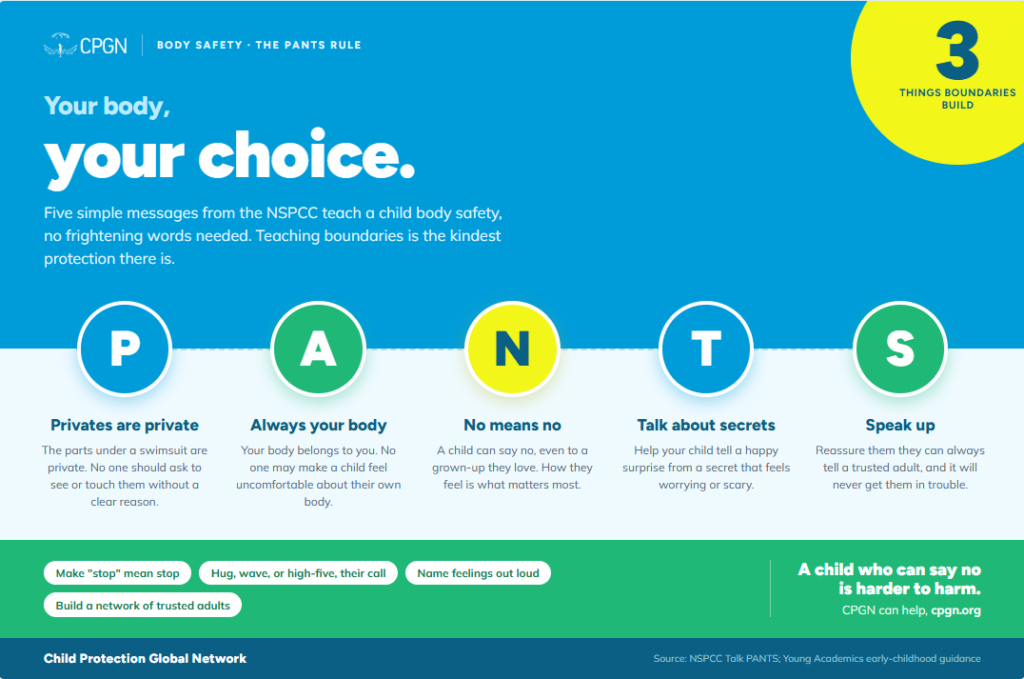
One of the clearest and least scary ways to teach body safety comes from the NSPCC, and it is known as the Underwear Rule, or PANTS. It lets you cover the essentials without ever mentioning frightening words. You can find the full Talk PANTS guide for parents on the NSPCC website. Each letter stands for a simple message:
How to Teach Kids to Say No
Saying no is a skill, and like any skill it needs practice and permission. Many children are taught to be good, which they often hear as always do what grown-ups say. Boundaries gently rebalance that.
Give your child the words. Simple phrases like “No thank you,” “Stop, I don’t like that,” or “I need some space” are easy to rehearse together during play. The more familiar the words feel, the more readily they will come when they are needed.
Then, crucially, honour their no whenever it is safe to do so. If your child does not want a hug, offer a wave or a high-five instead of overriding them. Forcing affection, even from love, teaches a child that their comfort is negotiable. Respecting it teaches the opposite.
- P, Privates are private. The parts covered by underwear are private, and no one should ask to see or touch them. Sometimes a doctor or carer needs to, but they should always explain why and ask first.
- A, Always remember your body belongs to you. No one has the right to make a child feel uncomfortable about their own body.
- N, No means no. A child is allowed to say no, even to a grown-up or someone they love. How they feel is what matters most.
- T, Talk about secrets that upset you. Help your child tell the difference between a happy surprise and a secret that makes them feel worried or scared.
- S, Speak up, someone can help. Reassure your child that they can always tell a trusted adult, and that speaking up will never get them into trouble.
It also helps to use the correct names for body parts from an early age. It may feel awkward at first, but it gives children the words to describe anything that worries them, and it quietly signals that no part of their body is shameful or secret.
Boundaries Go Both Ways
Consent is not only about a child protecting themselves. It is also about learning to respect other people. A child who is asked before being hugged learns to ask before hugging someone else.
Teach the flip side just as warmly. When a sibling says stop during play, stop means stop. When a friend does not want to share, that is allowed. These small lessons grow into adults who understand consent deeply, long before it ever becomes a conversation about anything more grown-up.
Everyday Ways to Teach Boundaries
Here are simple habits you can build into normal family life. None of them needs a special occasion.
- Model your own boundaries. Let your child see you say no kindly, and ask permission before entering their space.
- Make stop mean stop. In any physical game, freeze the instant your child or anyone else says stop. Every time, without exception.
- Name feelings out loud. “You seem cross that he took your toy” helps a child understand and trust their own emotions
- Use the right words for bodies. Correct, calm language removes shame and gives children a clear way to speak up.
- Talk about good and bad secrets. Surprises are fun and have an end date. Secrets that feel heavy or scary should always be shared with a trusted adult.
- Read books together. Age-appropriate picture books on bodies, feelings, and consent make these chats feel natural rather than serious.
- Build a safety network. Help your child name a few trusted adults they could always go to, so they never feel they have nowhere to turn.
Imagine a tickle fight that has gone on a beat too long. Your child gasps “Stop!” between giggles. The most important thing you can do is stop immediately, then say, “Thank you for telling me. I will always stop when you say stop.” In ten seconds, you have taught consent, trust, and self-worth, all through play.
Did You Know?
Teaching body autonomy is recognised by child-safety experts as a genuine protective factor. By helping children name their bodies, trust their feelings, and reject bad secrets, you remove the very tools that those who harm children rely on most: confusion and silence.
Boundaries Are a Gift That Lasts a Lifetime
Teaching children about boundaries is not about making them fearful or suspicious. It is the opposite. It is about raising children who feel safe in their own skin, who know their voice matters, and who trust that the adults around them will listen.
At Child Protection Global Network (CPGN), we see boundaries as one of the strongest forms of everyday protection a child can have. They work hand in hand with calm, respectful parenting, like the kind described in our guide to discipline without yelling or hitting, and with knowing the warning signs of child abuse. If you would like guidance or support, our Help & Resources page is here for you.
FAQS
Begin with everyday moments. Pause tickling when they say stop, let them choose whether to hug a relative, and name their feelings out loud. Keep it simple and age-appropriate, and remember that your own behaviour is their best lesson.
Body autonomy means a child understands that their body belongs to them and they have a say in what happens to it. It includes knowing their private parts are private, being allowed to say no to touch, and feeling safe to tell a trusted adult if something feels wrong.
It is best not to force affection. Letting your child choose how to greet people, with a hug, a wave, or a high-five, teaches them that their comfort matters and that no is respected. This builds a habit that helps keep them safe.
Mark S.
Mark S. is a dedicated child protection advocate and co-founder of Child Protection Global Network (CPGN). With a background in community development and public education, he supports CPGN’s mission to protect children from abuse and neglect through awareness, prevention education, and community guidance.
Through his work with CPGN, Mark helps families, educators, and communities better understand child safety, recognize warning signs, and take informed steps when a child may be at risk. His writing focuses on making child protection information clear, practical, and accessible for people who want to create safer environments for children.
Mark believes that protecting children begins with awareness, early action, and stronger community responsibility. His work reflects CPGN’s commitment to helping every child feel safe, heard, and protected.
All Posts
Copyright © 2026 CPGN. All rights reserved by Majnate LLP | Privacy Policy | Terms and Conditions