
Importance of Children’s Rights for a Brighter Future
Protecting children’s rights is one of the most important ways to build a safer, healthier, and more hopeful future. When children are protected from abuse, neglect, exploitation, and discrimination, they are more likely to grow, learn, heal, and reach their full potential.

- Mark S.
- Last updated 11 September 2026
What Are Children’s Rights?
Children’s rights are the basic rights, protections, and freedoms every child should have, no matter where they live, what their family background is, what language they speak, whether they have a disability, or how much money their family has.
In simple words, children’s rights mean every child deserves to be:
- Safe from violence, abuse, neglect, and exploitation
- Cared for by adults who protect their wellbeing
- Able to access education, healthcare, food, and safe shelter
- Treated with dignity and fairness
- Heard in decisions that affect their life
- Given the chance to grow, play, learn, and develop
The United Nations Convention on the Rights of the Child explains that all children’s rights are connected, equally important, and cannot be taken away. These rights are not rewards children earn. They are basic protections every child is entitled to because children are human beings with dignity, value, and potential.
This matters because children are still developing. They depend on adults, families, schools, communities, and governments to create the conditions they need to survive and thrive.
Every Child Has the Right to Be Safe
Help CPGN promote children’s safety, dignity, rights, and access to protection.
Protect a Child’s Rights ✓ U.S.-registered 501(c)(3) nonprofitWhy Are Children’s Rights Important for Society?
The importance of children’s rights goes far beyond laws or policy. Children’s rights shape the kind of future a child can build.
When a child is safe, supported, educated, and listened to, they have a stronger chance of becoming a healthy and confident adult. When those rights are ignored, the effects can continue for years, affecting mental health, learning, relationships, safety, and future opportunities.
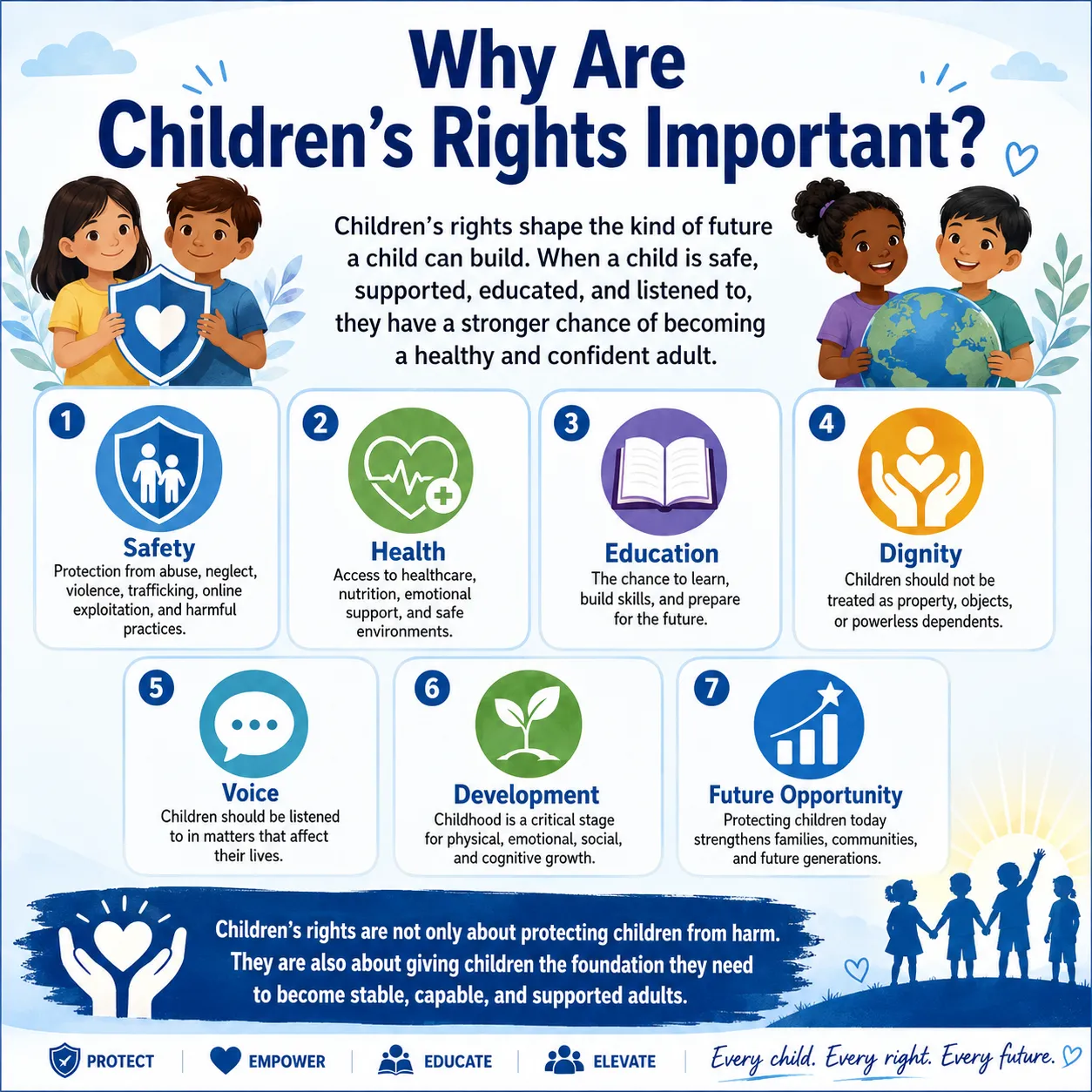
Children’s rights are important because they help protect:
- Safety — children need protection from abuse, neglect, violence, trafficking, online exploitation, and harmful practices.
- Health — children need access to healthcare, nutrition, emotional support, and safe environments.
- Education — children need the chance to learn, build skills, and prepare for the future.
- Dignity — children should not be treated as property, objects, or powerless dependents.
- Voice — children should be listened to in matters that affect their lives.
- Development — childhood is a critical stage for physical, emotional, social, and cognitive growth.
- Future opportunity — protecting children today strengthens families, communities, and future generations.
Children’s rights are not only about protecting children from harm. They are also about giving children the foundation they need to become stable, capable, and supported adults.
The Four Core Principles Behind Children’s Rights
Children’s rights are often understood through four major principles:
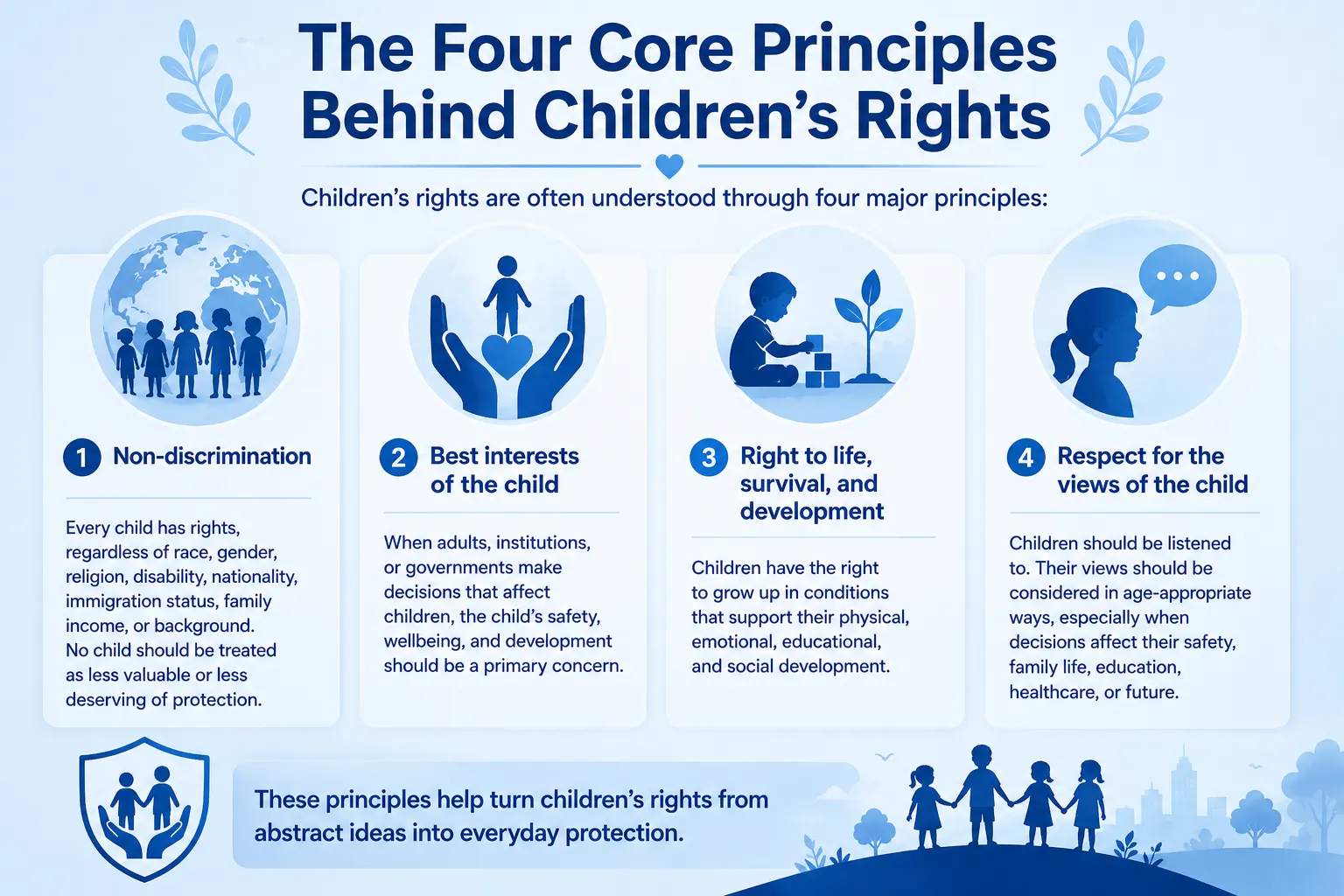
1. Non-discrimination
Every child has rights, regardless of race, gender, religion, disability, nationality, immigration status, family income, or background. No child should be treated as less valuable or less deserving of protection.
2. Best interests of the child
When adults, institutions, or governments make decisions that affect children, the child’s safety, wellbeing, and development should be a primary concern.
3. Right to life, survival, and development
Children have the right to grow up in conditions that support their physical, emotional, educational, and social development.
4. Respect for the views of the child
Children should be listened to. Their views should be considered in age-appropriate ways, especially when decisions affect their safety, family life, education, healthcare, or future.
These principles help turn children’s rights from abstract ideas into everyday protection.
Why Children Need Special Protection
Children have the same human dignity as adults, but they also need special protection because they are still growing and often cannot protect themselves alone.
A child may depend on adults for food, housing, safety, healthcare, education, emotional support, transportation, and access to help. If the adults around a child are unsafe, unavailable, abusive, overwhelmed, or unsupported, the child may become more vulnerable.
Children may be at higher risk when they experience:
- Poverty or housing instability
- Family violence
- Abuse or neglect
- Disability or developmental needs
- Discrimination
- School exclusion
- Unsafe online contact
- Trafficking or exploitation
- Caregiver substance abuse or mental health challenges
- War, migration, displacement, or community violence
This is why protecting children’s rights must involve more than responding after harm happens. Prevention matters. Stronger families, safer schools, supportive communities, and effective child protection systems can reduce risk before a child is seriously harmed.
Child Protection and Children’s Rights Are Connected
Child protection is the practical work of making children’s rights real.
Children’s rights tell us what every child deserves. Child protection helps prevent and respond when those rights are violated.
For example:
- A child’s right to safety means adults must protect them from abuse and neglect.
- A child’s right to education means schools must be safe, accessible, and supportive.
- A child’s right to health means children need physical and mental health care.
- A child’s right to be heard means children need safe ways to speak up when something is wrong.
- A child’s right to protection from exploitation means systems must respond to trafficking, child labor, sexual abuse, online exploitation, and harmful practices.
Children’s rights are the promise. Child protection is the action.
Key Facts About Child Abuse, Neglect, and Violence
The need to protect children’s rights is urgent because abuse, neglect, and violence continue to affect children across the world.
In the United States, the National Children’s Alliance reports that an estimated 532,228 children were victims of abuse and neglect in 2024. That equals about 7 children out of every 1,000. In 2025, Children’s Advocacy Centers served 365,140 children experiencing allegations of abuse.
These numbers are serious, but they still do not show the full picture. Many children never report abuse. Some are too young to explain what is happening. Others may be afraid, threatened, isolated, or unsure whether anyone will believe them.
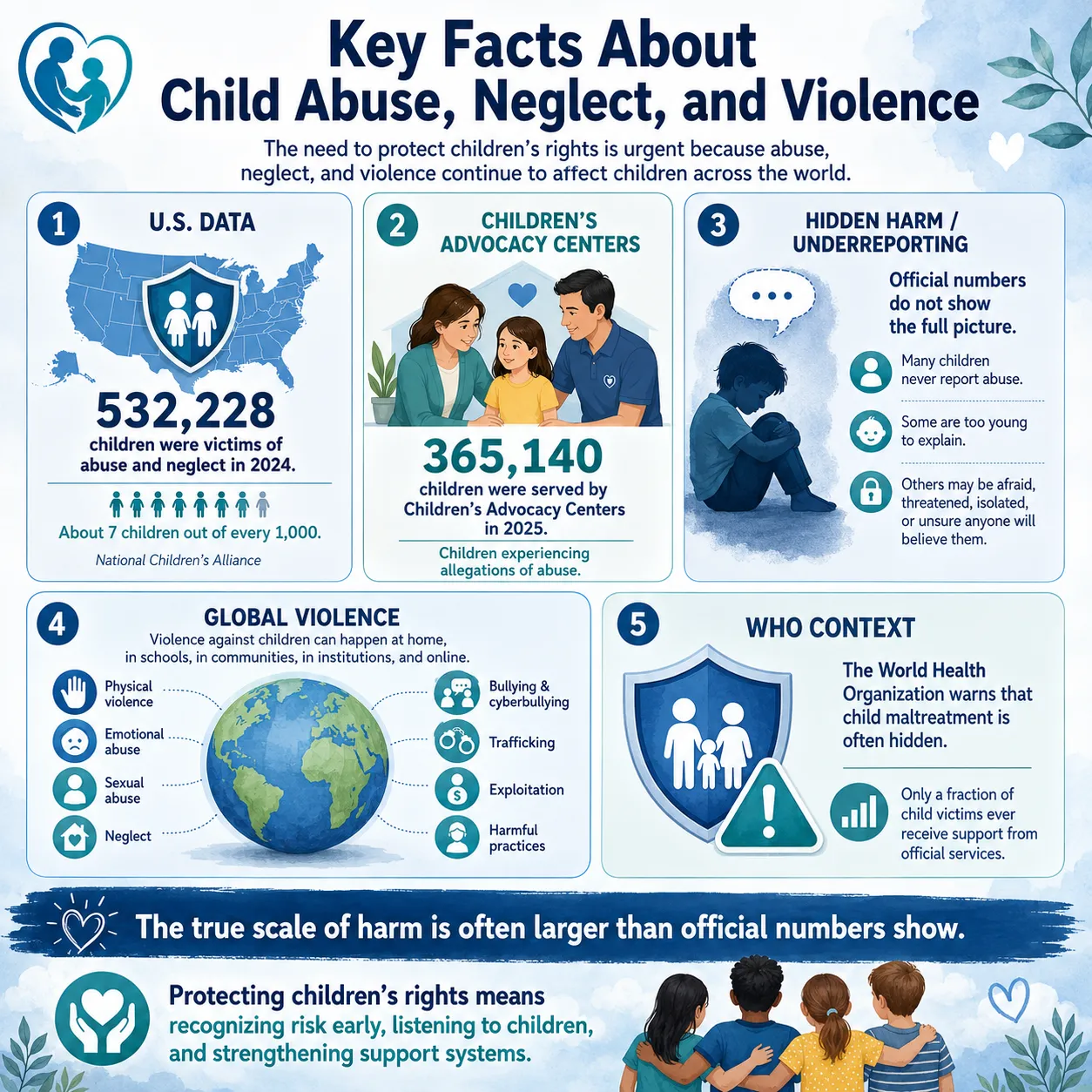
Globally, violence against children can happen at home, in schools, in communities, in institutions, and online. It can include physical violence, emotional abuse, sexual abuse, neglect, bullying, cyberbullying, trafficking, exploitation, and harmful practices.
The World Health Organization also warns that child maltreatment is often hidden and that only a fraction of child victims ever receive support from official services.
That means the true scale of harm is often larger than official numbers show.
What Happens When Children’s Rights Are Ignored?
When children’s rights are ignored, the harm does not always end when childhood ends.
Abuse, neglect, violence, and exploitation can affect a child’s brain development, emotional regulation, physical health, learning ability, trust, and relationships. Children who experience ongoing fear or trauma may struggle to feel safe, focus in school, form healthy attachments, or speak up when they need help.
The effects can include:
- Anxiety, depression, and post-traumatic stress
- Difficulty learning or concentrating
- Poor school attendance or lower academic performance
- Sleep problems or chronic stress
- Low self-worth or shame
- Difficulty trusting adults
- Higher risk of exploitation or repeat victimization
- Increased risk of later health and social problems
This does not mean a harmed child cannot heal. Children can recover with safety, support, trauma-informed care, stable relationships, and early intervention. But the earlier adults recognize risk and respond, the better the chance of reducing long-term harm.
Protecting children’s rights is not only about stopping immediate danger. It is also about protecting a child’s future health, confidence, relationships, and opportunities.
Childhood Harm Can Last a Lifetime
Support early protection, education, and advocacy that can help reduce trauma and protect a child’s future.
Help Protect a Child’s Future 🔒 Secure donation through GivebutterHow Children’s Rights Build a Brighter Future
A brighter future begins with safer childhoods.
When children’s rights are protected, children are more likely to:
- Stay in school
- Develop confidence and emotional security
- Build healthy relationships
- Access healthcare and mental health support
- Avoid exploitation and violence
- Participate in family, school, and community life
- Grow into adults who can support the next generation
Protecting children also benefits society. Communities with stronger child protection systems often carry fewer long-term costs related to trauma, poor health, school disruption, violence, homelessness, and family crisis.
When we invest in children, we invest in healthier families, safer communities, and stronger futures.
This is why children’s rights should not be treated as a side issue. They are connected to public health, education, justice, poverty prevention, family support, and community development.
Modern Threats to Children’s Rights
Today, threats to children’s rights are changing. Some risks have existed for generations, while others are growing because of technology, social disruption, and global instability.

Children may face risks such as:
- Physical abuse
- Emotional abuse
- Sexual abuse
- Neglect
- Bullying and cyberbullying
- Online grooming and exploitation
- Child trafficking
- Child labor
- Child marriage
- Domestic violence exposure
- Unsafe institutions
- Discrimination and exclusion
- Lack of access to healthcare or education
Online safety is especially important. Children can now be targeted through social media, gaming platforms, messaging apps, and other digital spaces. Protecting children’s rights today means protecting them both offline and online.
Child protection systems must be modern, community-based, trauma-informed, and responsive to new risks.
Who Is Responsible for Protecting Children’s Rights?
Protecting children’s rights is a shared responsibility.
Parents and caregivers are often the first line of protection. They help create safe, stable, and nurturing environments where children can grow. But families should not be left alone when they are struggling. Communities and systems must also provide support.
Responsibility belongs to:
- Parents and caregivers
- Teachers and school staff
- Healthcare providers
- Social workers and child protection professionals
- Faith and community leaders
- Law enforcement and courts
- Policymakers and governments
- Nonprofits and advocacy organizations
- Neighbors, relatives, and trusted adults
Children are safer when adults understand that protection is not “someone else’s job.” If a child may be at risk, the adults around that child have a responsibility to notice, respond, and seek help.
Who Is Responsible for Protecting Children’s Rights?
Good intentions are not enough. Protecting children’s rights requires practical action.
1. Learn the signs of abuse and neglect
Adults should understand warning signs such as unexplained injuries, sudden behavior changes, fear of going home, poor hygiene, extreme withdrawal, sexualized behavior, frequent absences, or a child directly saying something is wrong.
Internal link suggestion: Link to CPGN’s article on warning signs of child abuse.
2. Listen when children speak
Children may not always disclose harm clearly. They may hint, test whether an adult is safe, or describe something indirectly. Adults should respond calmly, believe the child, avoid blaming language, and seek appropriate help.
3. Build safe environments
Homes, schools, youth programs, and online communities should have clear safety rules, reporting pathways, adult supervision, and child-friendly ways to ask for help.
4. Support families before crisis
Many risks increase when families are isolated, overwhelmed, or unable to access help. Parenting support, mental health care, substance abuse treatment, safe housing, food security, and financial stability can all help reduce risk.
5. Report suspected abuse
If a child is in immediate danger, contact emergency services. If abuse or neglect is suspected, follow your local child protection reporting process. In the United States, this may involve contacting child protective services or a child abuse hotline.
6. Advocate for stronger systems
Communities can support policies and programs that improve child welfare, trauma-informed care, school safety, mental health access, family support, and prevention education.
7. Teach children about body safety and trusted adults
Children should know that they have the right to be safe, the right to say no to unsafe touch, and the right to tell a trusted adult when something feels wrong.
Children’s Rights and Responsibilities: A Better Way to Understand It
People sometimes talk about “children’s rights and responsibilities.” This phrase can be helpful if it is used carefully, but it should never suggest that children only deserve rights if they behave a certain way.
Children’s rights are not conditional. A child does not lose the right to safety, education, healthcare, dignity, or protection because they make mistakes.
A better way to explain it is this:
Children have rights, and adults have responsibilities to protect those rights. As children grow, they can also learn age-appropriate responsibilities such as respecting others, speaking honestly, caring for their community, and asking for help when they feel unsafe.
The main responsibility remains with adults, caregivers, communities, and systems.
How CPGN Supports Children’s Rights
Child Protection Global Network exists to raise awareness, share prevention resources, and support stronger action around child safety and child protection.
CPGN helps families, professionals, advocates, and communities better understand:
- Warning signs of child abuse and neglect
- Risk factors that can make children more vulnerable
- Protective factors that help keep children safe
- The importance of trauma-informed responses
- The role of communities in preventing harm
- How child rights connect to child protection
Through education, advocacy, awareness, and resource-sharing, CPGN works to support a future where more children are safe, heard, protected, and able to grow with dignity.
Children’s Rights Need Adult Action
Help CPGN educate communities and build safer, more protective futures for children.
Support Children’s Rights Today Contributions may be tax-deductible as permitted by U.S. law.What To Do If a Child May Be Unsafe
If a child is in immediate danger, call local emergency services right away.
If you suspect abuse or neglect, contact the appropriate child protection agency, hotline, or local authority in your area. If you are unsure where to begin, visit CPGN’s Help & Resources page for guidance and support options.
Do not investigate the situation yourself if doing so could place the child at greater risk. The safest step is to report concerns to the proper professionals who are trained to respond.
Final Thoughts: Protecting Rights Means Protecting Futures
The importance of children’s rights is simple but powerful: every child deserves the chance to grow up safe, healthy, educated, respected, and heard.
Protecting children’s rights is not only about preventing harm today. It is about shaping the future a child can build tomorrow.
When adults protect children from abuse, neglect, exploitation, and discrimination, they help create stronger families, safer communities, and healthier societies. A brighter future does not begin when children become adults. It begins now, with the choices adults make to protect them.
Sources:
This article references information from UNICEF, the United Nations Convention on the Rights of the Child, the World Health Organization, the CDC, the U.S. Children’s Bureau, and the National Children’s Alliance.
Disclaimer:
This article is for educational and awareness purposes only. It is not a substitute for emergency, legal, medical, or professional child protection advice. If a child is in immediate danger, contact emergency services or the appropriate child protection authority in your area.
FAQs
Children’s rights are the basic protections and opportunities every child needs to be safe, healthy, educated, cared for, and heard.
Children’s rights are important because they protect children from harm and help them grow into healthy, educated, and confident adults. They also support stronger families and safer communities.
Important children’s rights include the right to safety, education, healthcare, food, shelter, family care, protection from abuse and exploitation, non-discrimination, and the right to be heard.
When children’s rights are violated, children may experience abuse, neglect, trauma, poor health, disrupted education, exploitation, and long-term emotional harm.
Mark S.

CPGN is a 501(c)(3) nonprofit organization dedicated to protecting children and strengthening families.
Tax-exempt since August 29, 2024.
See a child in danger? If you are in immediate danger, call local emergency services. For guidance from CPGN, Get Help.
CPGN is a 501(c)(3) — donations are tax-deductible where applicable. Our goal is to ensure the safety and protection of every child until it is achieved.
Copyright © 2026 CPGN. All rights reserved by Majnate LLP | Privacy Policy | Terms and Conditions