
What is the History of Child Protection in America?
Child protection in America has evolved from informal community efforts to a structured system of laws, agencies, and advocacy focused on safeguarding children’s rights and well-being.
Child protection in the United States has evolved significantly over centuries. What began as isolated efforts by concerned individuals and charitable organizations has grown into a comprehensive system of legal frameworks, social work, and government support dedicated to ensuring children’s safety and well-being. The history of child protection in America reflects changing societal attitudes toward children, family responsibility, and the role of government in safeguarding vulnerable populations.
From early colonial America to modern times, the U.S. has experienced a continuous evolution in child welfare policies, driven by both societal awareness and scientific advancements. This article explores the key milestones, legal developments, and organizations that shaped child protection in America, highlighting how these developments have paved the way for the child welfare system as we know it today.
Quick Summary: What You’ll Learn
- Key milestones in the history of child protection
- The role of legal frameworks, social work, and community efforts
- How public awareness and advocacy shaped child welfare
- The ongoing efforts at CPGN to build a safer future for children
Early Beginnings: Colonial and Pre-20th Century America
Colonial Times and Early Recognition of Child Welfare
In the early days of colonial America, child welfare was seen as a private matter, with families and religious institutions primarily responsible for the care and protection of children. Harsh discipline and physical punishment were common and largely unregulated. The concept of protecting children from abuse was virtually non-existent, as children were often viewed as property or labor resources.
However, as American society evolved, so did the recognition of children’s rights. Early American colonies gradually developed laws to protect children from certain forms of mistreatment. For example, in Massachusetts, a 17th-century law was passed to protect children from being abandoned by their parents. It marked the early efforts to recognize the state’s responsibility in protecting children, even if they were still largely viewed as the responsibility of their families.
In the 19th century, a significant shift occurred as advocates for children began recognizing the social influences on child development, understanding that protection was needed not only from external dangers but also from abuse within homes. Early child protection efforts were driven by philanthropic individuals and child welfare advocates who saw the critical role of society in intervening to prevent child maltreatment.
The Mary Ellen Wilson Case (1874)
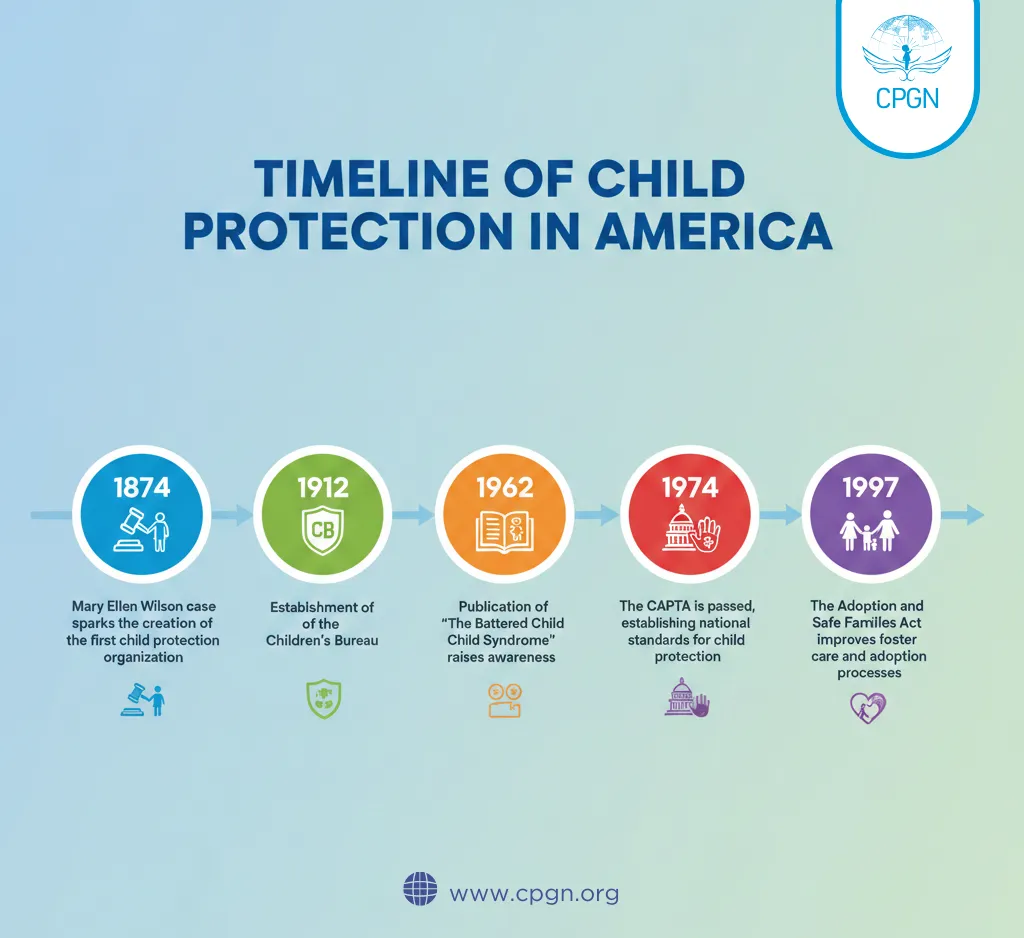
Mary Ellen Wilson’s 1874 case is often seen as a major turning point in the history of child protection in America. At the time, there was no clear child-specific legal system for rescuing a child from abuse inside a private home, which made her case especially important.
Etta Angell Wheeler sought help from Henry Bergh, founder of the ASPCA, and attorney Elbridge Gerry. They used an existing habeas corpus law to bring Mary Ellen before the court and remove her from the abusive home. Her case helped inspire the creation of the New York Society for the Prevention of Cruelty to Children, founded in December 1874 and incorporated in 1875.
One Child’s Story Changed History
Children still need adults who are willing to notice, speak up, and act. Help CPGN protect vulnerable children.
Help Protect Vulnerable Children ✓ U.S.-registered 501(c)(3) nonprofitEarly 20th Century: Legal and Institutional Advancements
The Children’s Bureau (1912)
In 1912, President William Howard Taft signed legislation creating the U.S. Children’s Bureau. It was originally established in the Department of Commerce and Labor, then transferred to the newly created Department of Labor in 1913. Its purpose was to investigate and report on matters affecting child welfare, child life, and the well-being of children across the country.
The Rise of Child Protection Laws
During this time, states across the U.S. began passing laws to address child welfare concerns. By the 1930s, states had begun to pass child labor laws, compulsory education laws, and laws that provided for the establishment of child welfare agencies. These laws began to define the state’s role in intervening in cases of child abuse and neglect.
The Mid-20th Century: Growth of Child Welfare Services
The Battered Child Syndrome (1962)
In 1962, the publication of “The Battered Child Syndrome” in the Journal of the American Medical Association (JAMA) by pediatrician C. Henry Kempe was a groundbreaking moment in child protection. Dr. Kempe’s research brought medical attention to the issue of child abuse, leading to a new understanding that children could be victims of intentional injuries by their caregivers. His work influenced both medical professionals and the public to recognize child abuse as a serious issue requiring intervention.
Kempe’s 1962 publication helped shift child abuse from a hidden family issue to a recognized medical, legal, and public-policy concern. His work helped drive the passage of mandatory child-abuse reporting laws; between 1963 and 1967, every U.S. state passed some form of mandatory reporting legislation.
The Child Abuse Prevention and Treatment Act (CAPTA) of 1974
Passed in 1974, the Child Abuse Prevention and Treatment Act, or CAPTA, became the key federal law addressing child abuse and neglect. CAPTA did not create mandatory reporting from scratch, since all states had already enacted reporting laws by 1967, but it strengthened the national child-protection framework by providing federal funding and guidance for prevention, assessment, investigation, prosecution, and treatment activities.
CAPTA also created national standards for the handling of child abuse cases and helped establish Child Protective Services (CPS) in every state, providing a framework for how cases of suspected abuse should be handled. This law also paved the way for the mandatory reporting laws that are still in place today.
Child-Protection Laws Began With Action
Help CPGN continue advancing child-safety awareness, prevention, and advocacy.
Support Child Protection Today 🔒 Secure donation through GivebutterLate 20th Century: Legal Reforms and New Child Protection Frameworks
Foster Care and Adoption Reform
In the 1980s and 1990s, significant reforms were made to improve the foster care system and adoption processes in the U.S. The Foster Care Independence Act (1999) aimed to provide support to older children aging out of foster care, ensuring they had access to housing, education, and employment opportunities.
The Adoption Assistance and Child Welfare Act of 1980 focused on family preservation and reducing the amount of time children spent in foster care by encouraging states to make efforts to reunite children with their biological families whenever possible, as long as it was safe to do so.
The Child Welfare System Today
Today, child protection in America is a multifaceted system that includes both federal and state initiatives aimed at ensuring the safety and well-being of children. Agencies like CPGN work alongside Child Protective Services (CPS), family courts, and community organizations to offer services that address child abuse, neglect, foster care, adoption, and family support. Key issues still facing the child welfare system include the overrepresentation of minority children, the mental health needs of children in care, and the challenges of family reunification.
The Evolution of Child Protection
The history of child protection in America demonstrates the evolving nature of society’s responsibility to protect its children. From the early days of recognizing child abuse as a social problem to the creation of federal agencies and legislation designed to prevent abuse, the U.S. has made significant strides in protecting children. Despite these advancements, challenges persist, and continued efforts are necessary to ensure all children grow up in safe, supportive environments.
We are writing the next chapter of child safety. Be a part of the future at CPGN.ORG and help us ensure that every child’s rights are protected.
About Child Protection Global Network (CPGN)
Child Protection Global Network (CPGN) is dedicated to providing advocacy, resources, and support for children in crisis worldwide. Our mission is to empower children, families, and communities to take action in creating safe and nurturing environments. We believe in building systems of protection that offer long-term security, resilience, and well-being for all children. Donate now or Get help to make a difference in the lives of children and families affected by parental alcohol misuse.
Help Write the Next Chapter of Child Safety
Support stronger systems, informed communities, and safer futures for children.
Donate for a Safer Future Contributions may be tax-deductible as permitted by U.S. law.FAQs
In 1912, the Children’s Bureau was established as the first federal agency focused on child welfare, marking the beginning of federal responsibility.
Consider seeking custody adjustments or supervised visitation through family court. Documentation of alcohol misuse strengthens your case for legal intervention.
Mary Ellen’s case led to the creation of the New York Society for the Prevention of Cruelty to Children (NYSPCC) in 1875, sparking the organized child protection movement.
The system has grown from philanthropic efforts in the 1800s to a complex legal and social work framework with mandatory reporting laws and professional support.
Mark S.
Mark S. is a dedicated child protection advocate and co-founder of Child Protection Global Network (CPGN). With a background in community development and public education, he supports CPGN’s mission to protect children from abuse and neglect through awareness, prevention education, and community guidance.
Through his work with CPGN, Mark helps families, educators, and communities better understand child safety, recognize warning signs, and take informed steps when a child may be at risk. His writing focuses on making child protection information clear, practical, and accessible for people who want to create safer environments for children.
Mark believes that protecting children begins with awareness, early action, and stronger community responsibility. His work reflects CPGN’s commitment to helping every child feel safe, heard, and protected.
All Posts

CPGN is a 501(c)(3) nonprofit organization dedicated to protecting children and strengthening families.
Tax-exempt since August 29, 2024.
See a child in danger? If you are in immediate danger, call local emergency services. For guidance from CPGN, Get Help.
CPGN is a 501(c)(3) — donations are tax-deductible where applicable. Our goal is to ensure the safety and protection of every child until it is achieved.
Copyright © 2026 CPGN. All rights reserved by Majnate LLP | Privacy Policy | Terms and Conditions