

Giving Tuesday is a great day to help children. But with so many charities asking for support, how do you know which one to trust?
This guide gives you a simple checklist. It uses free, official tools anyone can check in a few minutes.
Full disclosure: Child Protection Global Network (CPGN) is a child protection charity too. This checklist works for any charity, including us. Near the end, we show how CPGN measures up, so you can check us the same way.
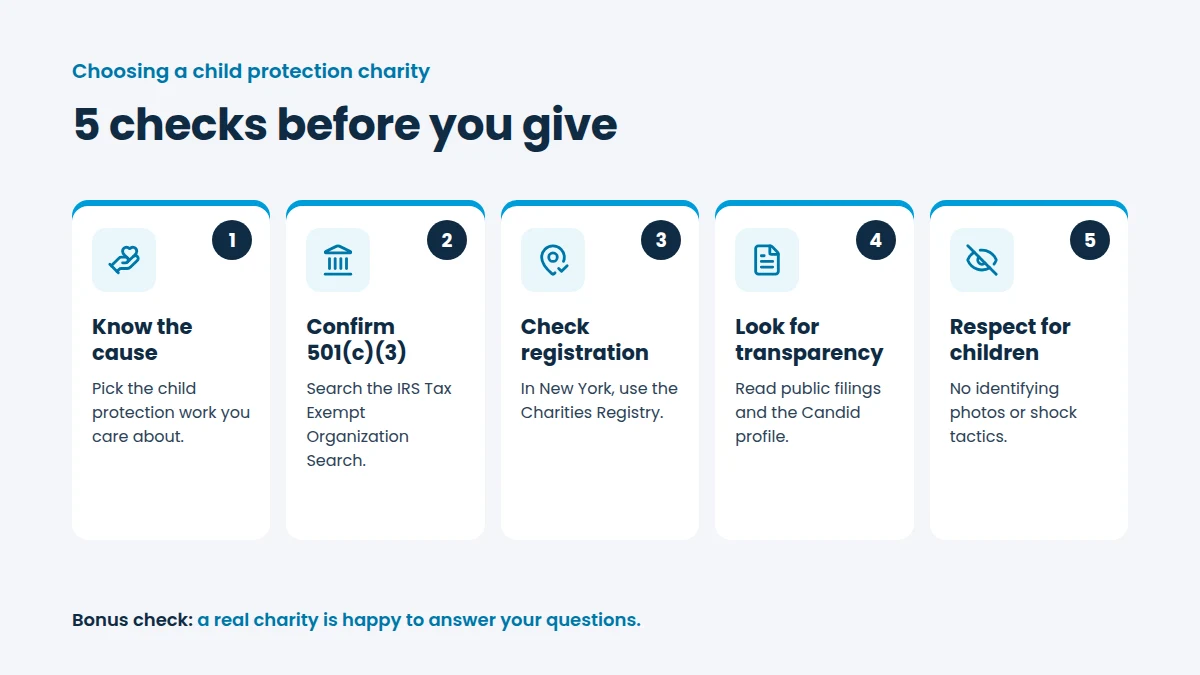
Quick Checklist: How to Choose a Child Protection Charity
- Know the cause. Pick the kind of child protection work you care about.
- Confirm it’s real. Check its 501(c)(3) status with the IRS.
- Check state registration. In New York, use the state Charities Registry.
- Look for transparency. Find its public filings and Candid profile.
- Check how it treats children’s stories. Look for respect and privacy.
- Ask questions. A real charity answers them.
Why Choosing Carefully Matters
The need is real. At least 1 in 7 children in the U.S. have experienced abuse or neglect in the past year, and this is likely an underestimate, according to the CDC.
That’s why your gift matters. And it’s why you want it to reach a charity that will use it well.
Sadly, scammers also know people give more during the holidays. The FTC warns donors to research charities before giving, especially when someone pressures you to give right away. Read the FTC’s advice on giving to charity safely.
Step 1: Know What Kind of Child Protection Work You Want to Support
“Child protection” covers many kinds of work. Knowing what you care about makes choosing easier. Common areas include:
- Prevention and education: teaching parents, teachers and caregivers to spot and prevent abuse.
- Family support: guiding families through child protection challenges.
- Direct services: shelters, counseling and child advocacy centers.
- Research: studying what puts children at risk and what helps.
- Advocacy: pushing for better laws, policies and accountability.
There’s no wrong choice. Pick the work that speaks to you.
Step 2: Confirm the Charity Is Real and Registered
Check Its IRS 501(c)(3) Status
Search the charity’s name or EIN on the IRS Tax Exempt Organization Search. This confirms it’s a recognized charity, and that your gift may be tax deductible.
Check Its State Registration
Many states require charities that ask for donations to register. If you live in New York, search the New York Charities Registry. In other states, check with your state attorney general’s office.
Step 3: Look for Transparency
Read Its Public Filings
Most U.S. charities file a yearly return with the IRS, called a Form 990. You can read many of them for free on ProPublica’s Nonprofit Explorer or Candid (GuideStar).
New and very small charities may file a short version, so there may be less to read. That’s normal.
Look for a Candid Transparency Seal
Candid gives seals to charities that share information about their work, people and finances on their profile. A seal shows a charity is willing to be open with donors.
Check Independent Reviews
Sites like Charity Navigator and the BBB Wise Giving Alliance review many charities.
Good to know: many small and young charities aren’t rated yet. No rating isn’t a red flag. It just means you’ll use the other checks in this guide.
Step 4: Check How It Treats Children’s Stories
This step matters most for child protection charities.
A trustworthy charity protects children’s privacy and dignity. Look for these signs:
- It doesn’t share photos or names that could identify children who were harmed.
- It doesn’t use shocking images or fear to pressure you into giving.
- It explains its work honestly, without exaggerated claims.
- It shares safety resources, like where to report abuse.
How a charity talks about children tells you a lot about how it treats them.
Step 5: Ask Questions
A real charity is happy to answer questions. You might ask:
- What programs will my gift support?
- Are you registered in my state?
- Where can I see your public filings?
- How do you protect children’s privacy?
If a charity won’t answer, or gives vague replies, think twice.
Red Flags to Watch For
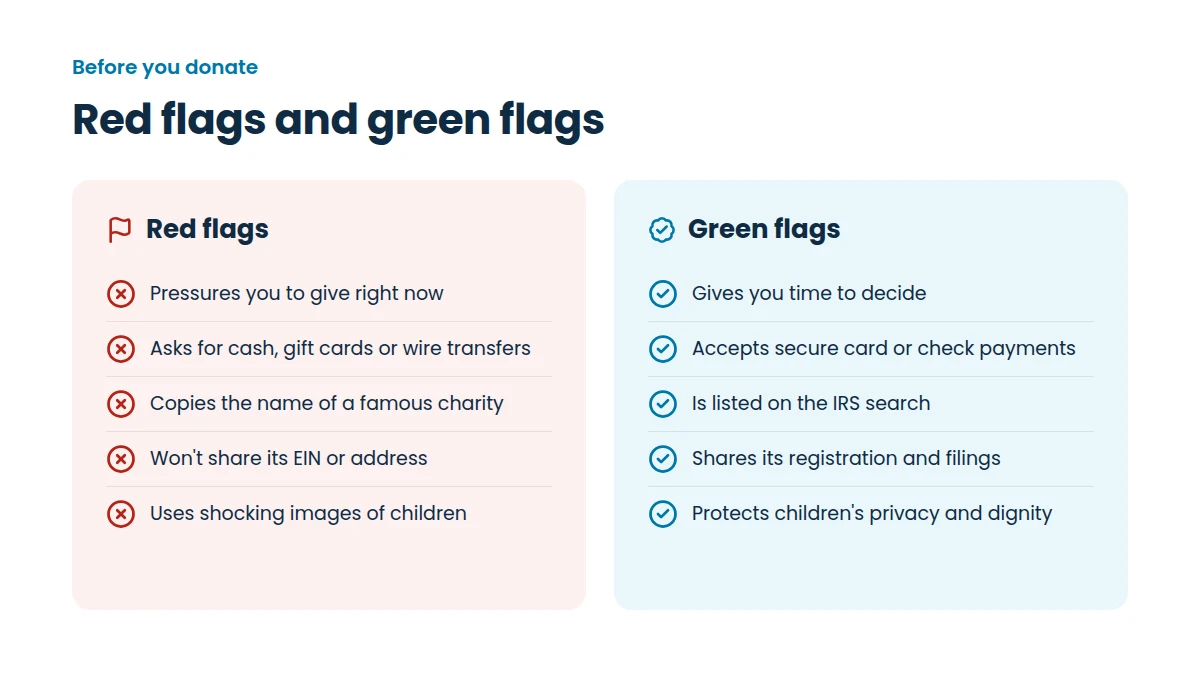
Be careful if a charity or fundraiser:
- Pressures you to give right now.
- Asks for cash, gift cards or wire transfers.
- Uses a name very close to a well-known charity.
- Won’t share its EIN, registration or address.
- Makes big promises it can’t back up.
- Thanks you for a gift you don’t remember making.
These warning signs come from the FTC’s advice on avoiding charity scams.
How CPGN Measures Up
We believe you should check us the same way. Here’s how Child Protection Global Network measures up against this checklist:
| Check | CPGN |
|---|---|
| IRS 501(c)(3) public charity | Yes. EIN 99-4920620. Verify on the IRS site. |
| Registered in New York | Yes, with the New York Charities Bureau. |
| Candid profile | Yes, with a Candid Silver Transparency Seal 2026. View our Candid profile. |
| Clear programs | Education, family support, research, systemic advocacy and forensic review. See what we do. |
| Respect for children’s privacy | We don’t share identifying details of children or families in our public materials. |
| Answers questions | Yes. Email us anytime at childprotection@cpgn.org. |
We’ll also be honest: CPGN is a young organization. We were incorporated in New York in 2024, so we don’t have many years of results to show yet. Early supporters help shape what we’re able to build.
Give Safely This Giving Tuesday
Giving Tuesday 2026 is on Tuesday, December 1. New to it? Read how Giving Tuesday works and the meaning and history of Giving Tuesday.
If you’d like to help protect children, we’d be grateful for your support. Your gift helps CPGN provide free child safety education, guide families through child protection challenges, and push for stronger systems that protect children.
Prefer to give directly? Donate securely on Givebutter. You can choose a one-time or monthly gift.
Planning more than one gift this season? See Giving Tuesday vs Year-End Giving: Do You Need to Choose?
If a child is in immediate danger, call 911. To report concerns or get support, contact the Childhelp National Child Abuse Hotline at 1-800-422-4453. CPGN is not an emergency service.
FAQs
How do I know if a child protection charity is legitimate?
Check its 501(c)(3) status on the IRS Tax Exempt Organization Search, confirm its state registration, and look for its public filings or Candid profile.
Is my donation to a child protection charity tax deductible?
Gifts to 501(c)(3) public charities are generally tax deductible to the extent allowed by law. Keep your receipt and check with a tax advisor.
Should I avoid new charities?
Not necessarily. New charities may have fewer years of results, but you can still check their IRS status, state registration and transparency.
What if a charity isn’t rated by Charity Navigator?
Many small and young charities aren’t rated yet. That isn’t a red flag. Use the other checks in this guide instead.
What are the signs of a fake charity?
Pressure to give right away, requests for cash, gift cards or wire transfers, a name that copies a famous charity, and refusing to share basic details.
When is Giving Tuesday 2026?
Giving Tuesday 2026 is on Tuesday, December 1, 2026.
Written by the CPGN Team. This article is for general information and isn’t tax or legal advice.


